
Introduction
If you are an Irish contractor - working through agencies in Dublin, Cork, or remotely for clients across Ireland - setting up your own private company limited by shares (LTD) is one of the most common routes once day rates and contract length justify moving beyond umbrella PAYE.
Ireland offers a relatively straightforward CRO process for a simple LTD setup. This guide is written specifically for a personal limited company: a single contractor working long-term assignments, or someone planning to become a long-term contractor in Ireland. It is practical guidance only - not an official rule book from the Irish government. Regulations and filing processes change; if you manage incorporation yourself, it is your responsibility to stay on top of the latest Revenue and CRO requirements.
Many Irish contractors choose an umbrella company instead because it eliminates the risk and admin of bookkeeping, payment processing, and running payroll for a limited company. If you still want your own LTD, the steps below walk through the CORE portal from start to finish.
Total CRO fees to incorporate
Expect to pay €25 to reserve your company name (Form RCN) and €50 to incorporate (Form A1) - €75 in total paid directly to the CRO before your company exists.
Why Irish Contractors Set Up a Limited Company
Contracting in Ireland typically means invoicing an agency or end client for professional services - often IT, engineering, finance, or pharma. When your day rate climbs and contracts run six months or longer, running those invoices through your own LTD can improve how you extract income, claim trade expenses, and retain profits in the company.
A personal LTD is not for every contractor. Agencies that insist on PAYE-only engagement, short three-month contracts, or contractors who want zero admin are usually better served by umbrella employment. But if your clients accept corporate invoicing and you are committed to contracting in Ireland for the long term, incorporation is the natural next step.
- Agency-friendly structure - Most Irish tech and professional services agencies accept LTD contractors alongside PAYE umbrella workers.
- Broader expense rules - Company-level deductions can suit contractors with significant business costs (see our limited company expenses guide).
- Profit retention - Leave cash in the company for pensions, future contracts, or tax-efficient extraction later.
- Separate legal entity - Your company contracts with clients; you are a director and shareholder, not an employee of the end client.
Before You Start: Umbrella vs Limited Company
A personal LTD gives you control over invoicing, profit retention, and expense structure - but you carry the compliance burden: CRO filings, corporation tax, payroll if you take salary, VAT if applicable, and annual accounts.
An umbrella company employs you under PAYE, handles invoicing and payroll, and includes statutory filings in a monthly fee. For many Irish contractors, that trade-off is worth it until day rates and contract length justify the extra structure and the €75 CRO filing cost.
- Limited company - Best when you expect higher net extraction after tax, can manage (or outsource) accounts, and clients accept LTD invoicing.
- Umbrella company - Best when you want PAYE simplicity, faster setup, and no CRO incorporation wait.
Step 1: Go to the CRO and Open CORE
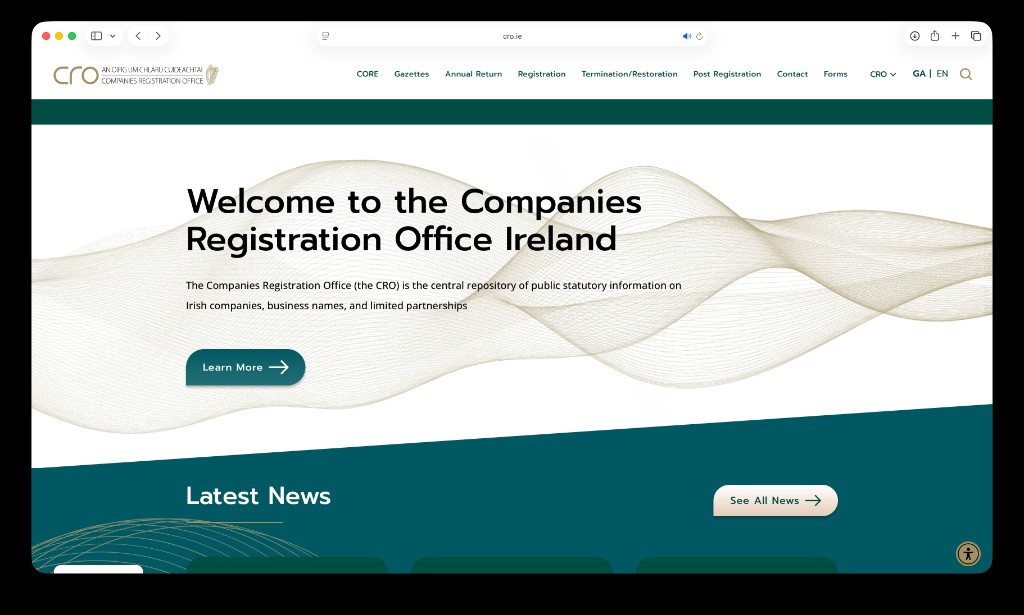
Start at the Companies Registration Office (CRO) website. From the main navigation, click CORE - the Companies Online Registration Environment. This is the portal where you reserve a company name and file your incorporation application.
Step 2: Create a CORE Login
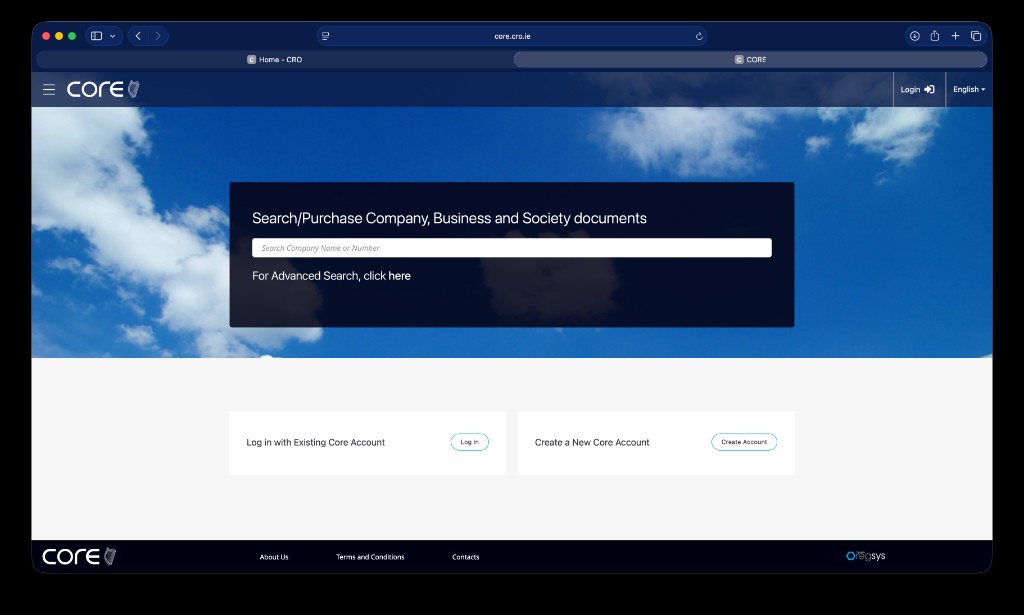
On the CORE homepage at core.cro.ie, choose Create Account if you do not already have credentials. You will need personal details and a verified email address to complete registration.
Once your account is active, log in. You will land on the CORE dashboard with access to Search, New Filing, My Filings, and other tools used throughout the incorporation process.
Step 3: Reserve Your Company Name (Form RCN)
Before you can incorporate, you must reserve your company name using Form RCN: Reservation of a Company Name. This is separate from registering a business name or trading name - RCN is for new companies and change-of-name submissions only.
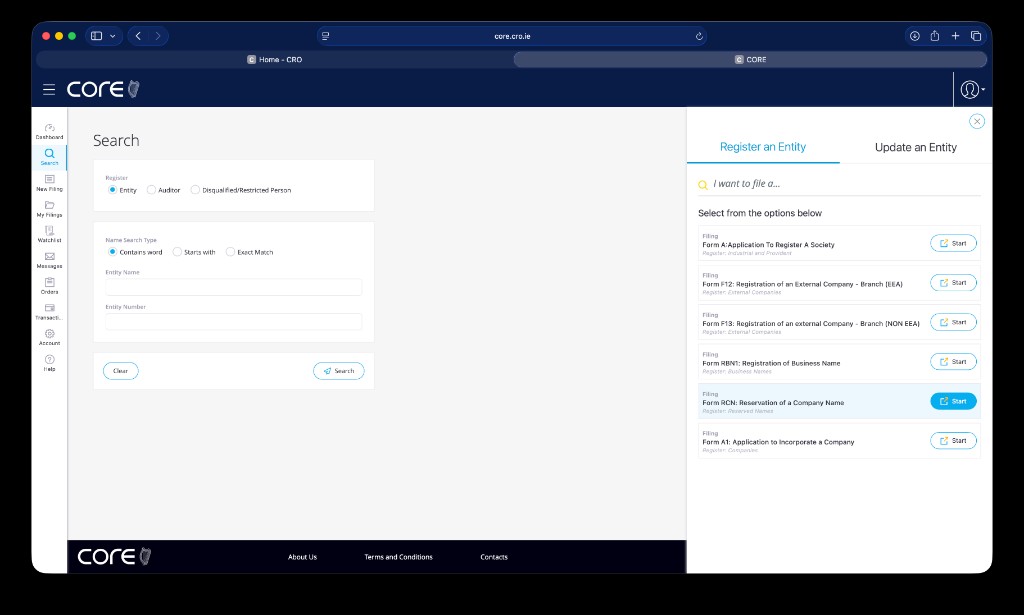
First, use the Search option in CORE to check whether your chosen name is already taken. Search by entity name with "Contains word" or "Exact Match" to see existing registrations. If the name appears free, start Form RCN from the Register an Entity panel under New Filing.
On the RCN form, enter the company name you want to reserve and click Check Name. If the name is acceptable, complete the submission and pay the €25 reservation fee. This fee is non-refundable, even if you later decide not to incorporate.
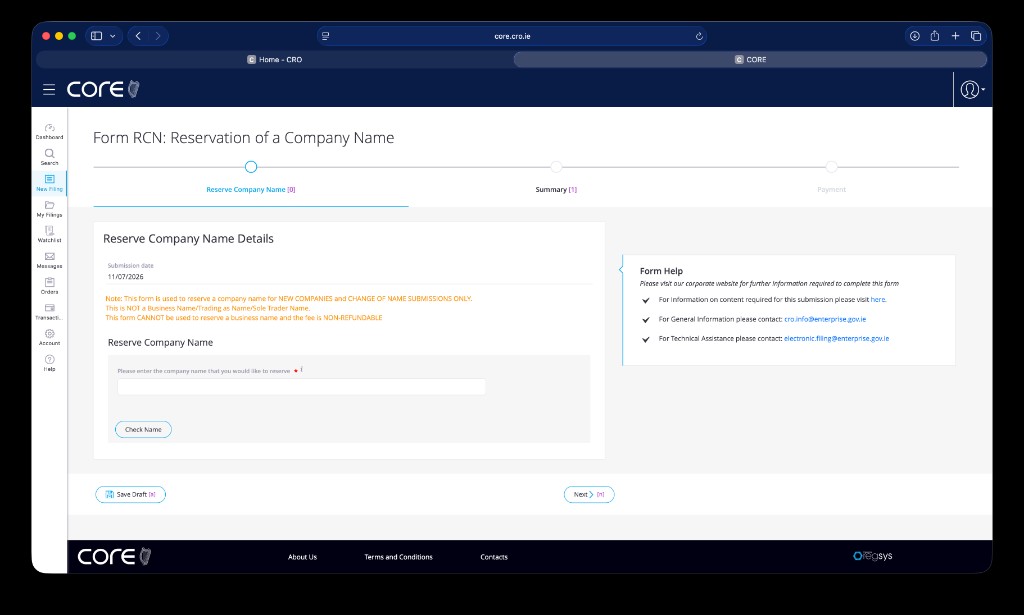
- Fee: €25 (non-refundable)
- Typical turnaround: Often same day, once the name passes checks
- Output: A reserved name certificate and reservation number - keep both for Form A1
Step 4: Incorporate with Form A1
After you receive your name reservation certificate, file Form A1: Application to Incorporate a Company. You will find it in the same Register an Entity panel, directly below Form RCN.
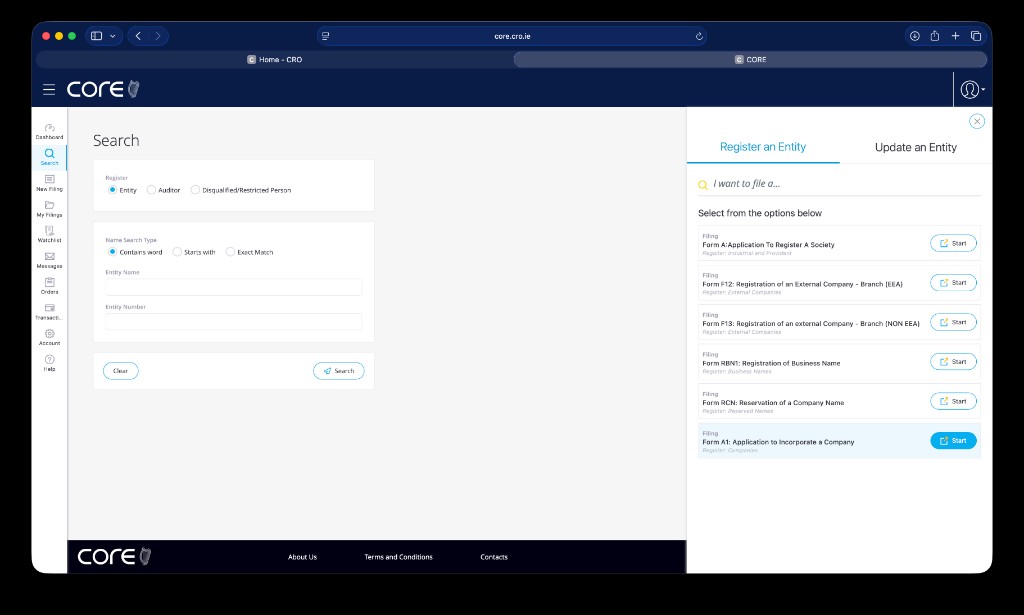
Form A1 walks you through eight stages. Work through each section carefully - errors or missing documents will delay processing. When you reach the Summary stage, you pay the €50 incorporation fee to the CRO. Combined with the €25 name reservation, your total CRO cost to set up a contractor LTD in Ireland is €75.
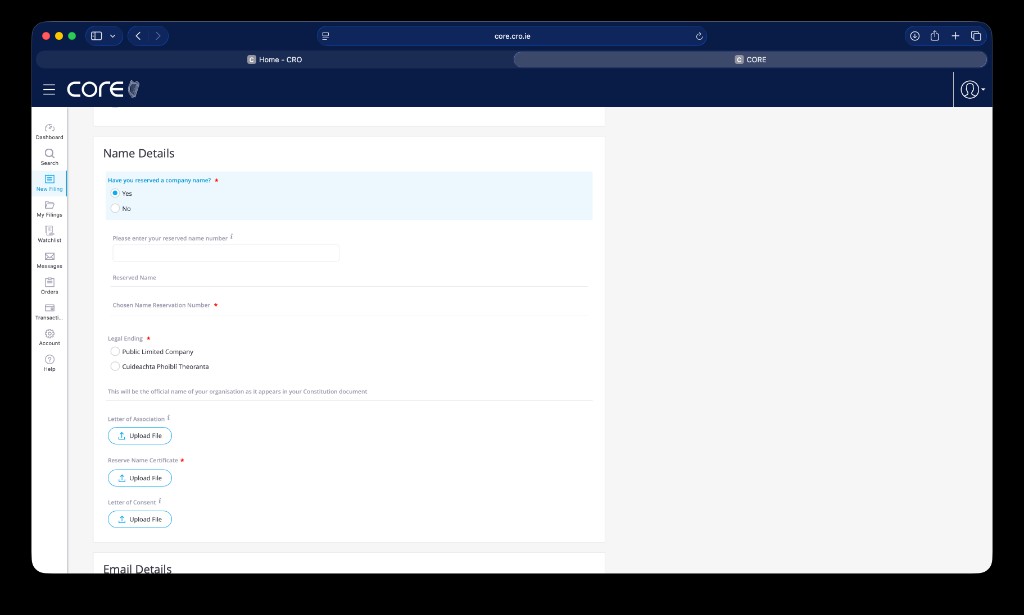
- Company Details [0] - Enter your reserved name number, upload the Reserve Name Certificate, and select the legal ending (for an Irish contractor LTD, choose Private Company Limited by Shares / Teoranta).
- Appoint New Director/Secretary [1] - Appoint yourself as director. Every Irish company needs at least one director and a company secretary.
- Other Directorship Details [2] - Declare any other directorships you hold, if applicable.
- Company Share Capital [3] - For a personal contractor LTD, allocate 100% of shares to yourself. A common setup is €100 issued share capital (e.g. 100 shares at €1 each).
- Subscribers to Memorandum [4] - Confirm who is subscribing to the shares (you, as sole shareholder).
- Declaration [5] - Sign the statutory declaration confirming the information is correct.
- Verification [6] - Complete identity verification as required by CRO.
- Summary [7] - Review all details, pay the €50 incorporation fee, and submit.
CRO fees at a glance
Form RCN (name reservation): €25. Form A1 (incorporation): €50. Both fees are paid to the CRO and are separate from accountant, secretary, or registered agent charges.
On the Name Details screen, select Yes when asked if you have reserved a company name, then enter your reservation number and upload the certificate issued after Form RCN.
Company Secretary and Share Structure
As a sole contractor, you will typically be the sole director and sole shareholder. Irish law also requires a company secretary - a separate person or a registered agent who handles CRO filings and maintains statutory registers.
Paytube can act as your company secretary for a small charge, handling the statutory obligations that come with incorporation. Email support@paytube.ie with any questions about company incorporation or ongoing limited company accounting.
Processing Times: DIY vs Registered Agent
If you file Form A1 yourself through CORE, current CRO processing times are typically 1 to 1.5 months before your company is incorporated and you receive your certificate.
Paytube is a registered agent with the CRO. When we file incorporation on your behalf, processing is significantly faster - usually 1 to 2 weeks. If timing matters for a contract start date, reach out before you submit.
Worth knowing
Incorporation is only the first step. After your company exists, you still need Revenue tax registration, a business bank account, and ongoing CRO and tax compliance.
What Happens After Incorporation
Once the CRO issues your certificate of incorporation, your company is a separate legal entity and you can start contracting through it. For Irish contractors, the next practical steps are:
- Register for tax with Revenue - Corporation tax, employer PAYE/PRSI if paying yourself a salary, and VAT if your turnover requires it. Your company needs a tax reference before you can invoice Irish clients properly.
- Open a business bank account - Irish banks will ask for your CRO certificate, constitution, and director ID. Keep company and personal money separate from day one.
- Set up payroll or dividend extraction - Most contractor directors take a modest salary plus dividends; plan this with an accountant before your first assignment payment arrives.
- Sign contracts and invoice as the LTD - Your company - not you personally - contracts with the agency or end client. Payment lands in the company account.
For allowable business expenses once trading, see our guide to limited company expenses in Ireland. If you decide the admin is not worth it, Paytube's umbrella service gets you contracting under PAYE without incorporation.
Important Disclaimer
This article is general guidance for Irish contractors considering a personal limited company. It is not legal, tax, or financial advice. CRO forms, fees, and processing times change - always verify current requirements on cro.ie and revenue.ie before filing.
Paytube provides payroll and accounting services but does not replace professional advice tailored to your circumstances. Consult a qualified accountant or tax adviser before incorporating.
Need help with contractor expenses?
Paytube processes unlimited expenses for umbrella contractors and supports limited company accounting.
Talk to our teamUmbrella servicesTake-home pay guide